Month: March 2015

The Basics on Chinese Herbs

Bulk Chinese herb preparations are one form of supplementation in Chinese herbal medicine. Others are freeze-dried concentrates, as well as various pill forms, and externally applied liniments, washes and plasters. More than three hundred Chinese herbs and medicinal substances are commonly used in herbal prescriptions that have a history of use dating back more than 2,000 years.

Today it is important that sources of these medicinals are made using highest quality raw materials and processing standards such as GMP *Good Manufacturing Practices,” which lab tests for microbial contaminants, heavy metals and pesticide residues. It is also important to be aware that no form of endangered species, pharmaceutical contaminants, lactose, corn, wheat, or sugar are part of medicinals. Over the course of history, vast experience has been gained in perfecting clinical applications, as well as in ethical, healthy sourcing of Chinese herbal medicinals.

Pictured is some of my medicinal pharmacy. • Image Reserved © Elemental Changes 

Posted by Wendy in analytical

Living in Simplicity

Zangetsu 残月, a Chinese master during the Tang dynasty, wrote the following advice to his students:

• Live in the world, yet not by forming attachments to the dust of the world.

• Poverty is your treasure. Modesty is the foundation of all virtues. Never exchange it for an easy life.

• Let your neighbors discover you before you make yourself known to them.

• To a sincere student, every day is a fortunate day.

• Pass each day in peaceful contemplation and leave results to the great law of the Universe.

This is the way of the student of Zen and Tao.www.ElementalChanges.com Simplicity

acupuncture asheville

acupucture asheville wendy brown

acupuncture asheville wendy brown

acupuncture asheville wendy brownwww.ElementalChanges.com Simplicity

 Rural Chinese families and all of their possessions by Chinese photographer Huang Qingjun 黄庆军

Photos copyright the artist

Courtesy 798 Photo Gallery


Posted by Wendy in analytical

Chinese Congee Cooking Tutorial

✍️Wendy Brown, Lic. Ac.

Congee, also known as Jook, is a long-cooked rice porridge that conveys notable nutritive effects to the Spleen and Stomach Qi, which are the roots of postnatal Qi, acquired from what is digested, and known in Chinese medicine as Gu Qi. Congee is a simple food that promotes the prosperity of good health. Congee is often a perfect food for introducing infants to solid food. Congee is essential for everyone, from our pediatric friends to elders, people of delicate constitutions, and everyone in between. There is a Chinese adage: “One receives more health benefits by eating congee to their fill than by drinking of any amount of Chinese medicinal wine”. Eating healthy, well-prepared food requires some planning but is the only way to maintain the health of Spleen and Stomach Qi, produce Blood, and nourish Body-Mind-Spirit.

Try this stovetop recipe for starters

1 Part Organic (Sushi or Short Grain) White Rice to 8 Parts Water – so, 3/4 cups of rice to 6 cups of water, etc. Bring rice and water to a boil, then down to the lowest simmer. Cook for 4 hours on the stove with the lid on the pot. To provide a nourishing breakfast, a crockpot may be used to cook congee overnight. Set the crock pot on low for 8 hours.

Depending upon the condition of the person, the following are nice additions to breakfast congee:

6 grams of Cinnamon, 6 slices of fresh Ginger Root,

3 Red Dates, 2 tablespoons of Honey, 6 mashed Walnut halves

There are many medicinal foods that you can add to congee for various health benefits. For example, rich in nutrients of vitamin C and calcium, and sweet, astringent, and cold in therapeutic nature, persimmon enters the lung, spleen, and stomach meridians. Directing stomach Qi downward, it treats epigastric pain, hiccups and belching, mouth ulcers, and high blood pressure. Persimmon fruit (much like loquat, lily bulb, and fig, which are also congee additions one could opt for) engenders essential Yin fluids that moisten the lungs and help to treat a dry, painful throat. Fortifying the spleen, Persimmon also treats dysentery and some lower G.I. bleeding.
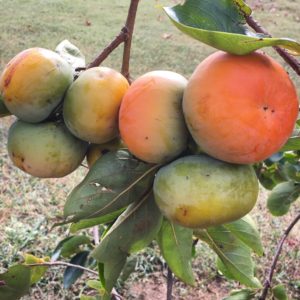
A profusion of ripening persimmon fruit in the garden. Mother Nature’s abundance! Image ©W.Brown

Pearl and Jade Breakfast Congee

Here is a fortifying cool-weather congee recipe using persimmon and other herbs to supplement Yang, boost Heart, Lung, and Kidneys, and warm the extremities. It enriches the Lungs, Spleen, and Expels Phlegm

9-18 grams Chinese White Yam (Shan Yao)

9-18 grams Job’s Tears (Yi Yi Ren)

5-12 grams Persimmon Fruit (Shi Di)

1 Part Organic White Rice to 8 Parts Water. Bring rice and water to a boil, then down to the lowest simmer. Cook on very low or simmer for 4 hours with the lid on the pot. If using a crock pot, congee can be left cooking overnight for 8 hours on the low setting.

Regurgitation, Reflux, and Damage from Food Stasis (Add-in) 3 grams Hawthorn (Shan Zha), 10 grams Tangerine Peel (Ju Pi), 5 Pieces Red Date (Hong Zao), 5-12 grams Persimmon Fruit soaked in warm to hot water for 10 minutes first, Honey (Feng Mi) to taste.

Harmonize Digestion Following Cold Illness (Add-in) 10 grams Tea Leaves (Folium Camellia Thea), 3 Slices Ginger (Sheng Jiang), 2-3 Clove Buds (Ding Xiang), 5-12 grams Persimmon Fruit soaked in warm to hot water for 10 minutes first, Honey (Feng Mi) to taste.

Useful References

Chinese Medicinal Teas: Simple, Proven, Folk Formulas for Common Diseases, By Xiao-Fan Zong and Gary Liscum.

The Book of Jook: Chinese Medicinal Porridges, By Bob Flaws.

Contraindication 

Simple congee is a perfect food, although rice, before long cooking time, disinhibits water and is thus mildly diuretic. Mung, Adzuki, and fermented beans are also lightly diuretic and should not be added to congee in wintertime as these medicinal foods will further add to draining valuable Yang Qi, particularly in people who exhibit urinary frequency. Use all medicinal substances and methods with care and proper understanding.

This-> www.ElementalChanges.com Congee is an example of the consistency I aspire towards when making congee. The very smooth, cream-like texture requires adding more water on an hourly basis and more hours of simmering, which many will not wish to undertake. All congee variations hold nutritional and healing properties, so enjoy what yours turns out to be.

Health and Best Wishes 
Please Enjoy & Share
Posted by Wendy in analytical
Bach Flower Essences

Bach Flower Essences

At their inception in the 1930’s, flower essences were conceived of by Dr. Edward Bach, MD., a visionary allopathic physician who comprehended the connection between feelings and actual physical illness, and sensed the bridge made possible to treat them by the original 39 essences he worked with. Flower essences are dilutions of flower or tree material, which through the sunlight-fueled process, become resonant with the vibrational qualities of each plant or tree. Flower essences are an energetic approach which address subtle layers of spirit-psyche. They are gentle, non-invasive, non-habit-forming, and engender no residual bio-chemical changes or side-effects whatsoever, which makes them entirely compatible with all other forms of treatment. The flower dilutions are suspended in a 50:50 solution of water and brandy. Each dosage should be diluted in at least one half liter of spring water if there is a known intolerance to alcohol. Up to 6 remedies can be effectively combined, although taking one remedy or a combining of two are usually suitable for deeper, long-standing characteristics. 

Bach flower essence treatment falls within the realm deemed vibrational medicine, as would stones and crystals, aromatherapy, harmonic sound therapy, colorpuncture, and modalities based upon subtle-body resonance that reconciles energetic balance to the person. Flower essences are allies in shifting more subtle processes and therein encourage states of wholeness in people and in animals. Dr. Bach recognized the energetic signatures or ‘etheric tones’ inherent in trees and flowers and remarkably found a way to impart the essence and attributes of their presence in nature. Dr. Bach pioneered in this visionary form of treatment, and since his genius in the 1930’s, there have been further explorations into the uses of flower essences, both internally and externally. Bach Flower Essences, as well as other essence purveyors, can be sourced in most health food stores.


Pictured is one of my two sets of Bach flower essences. This set dates back to their original purchase made by my father in 1981 from the Bach Centre in the U.K.


Preparing Flower Essences 

• Use a two ounce tincture bottle with dropper

• Fill it with pure water

• Add 4 drops of each of the remedies you wish

• Shake gently before each use

• Administer 4 drops under the tongue, 4 times per day

Note: Rescue Remedy is available pre-mixed and may be administered directly from the bottle under the tongue, with frequency as needed.

With All Best Wishes

If you would like to explore Bach flower essences further you may appreciate the following: Bach Essence Questionnaire

Posted by Wendy in analytical

Chinese Herbs, Individualized Medicine

Every instance of illness has a unique configuration and requires unique (not fixed) treatment. To relieve the suffering of the times, there is no greater path than Chinese medicine. Within it, nothing is more effective than prescriptions of herbs and materials for each individual’s condition.

Image© Elemental Changes & Wendy Brown, Lic. Ac.

  Wellness Best Wishes to All Image© Elemental Changes Oriental Medicine.


Posted by Wendy in analytical